
Troubleshooting
Sub-Zero Ice Maker Not Making Ice: the Checks to Run Before You Book Anyone
Most Sub-Zero ice makers that stop have one of five causes: the ice maker is switched off or the arm is held up, the freezer is not cold enough, the water supply is closed or restricted, the fill tube has frozen, or the filter is overdue. All five are checkable in about twenty minutes without tools, and the first two account for a surprising share of the calls we take.
The full guide
Start here: how ice actually gets made
Five things have to be true, every cycle. Knowing them is what makes the checks below an elimination rather than a guess.
- The ice maker is switched on and the shut-off arm is not holding it off.
- The freezer is cold enough — around 0°F.
- Water reaches the fill valve at adequate pressure.
- The fill tube is clear, so the water gets into the mold.
- The mechanism can turn and eject.
Break any one and you get no ice, with no message on the display. The checks below work through them in the order that eliminates the most for the least effort.
We will say this plainly: a good share of these calls end without anybody coming out. Saying so costs us visits, and it is the reason the people we do come out to trust the diagnosis.
Check 1: is it actually switched on
Not the joke it sounds like. It is genuinely the most common finding.
The control panel. The ice maker can be turned off independently of the freezer, and it happens — during a cleaning, a holiday, a filter change, or by somebody pressing something while getting the frozen peas out. Confirm it is enabled.
The shut-off arm. Most ice makers have a wire arm or a sensor that stops production when the bin is full. If the arm is held up by a bag of ice, a package leaning against it, or by having been lifted and not put back, the ice maker believes the bin is full and stops. Move everything away from it and check the arm falls freely.
A bin that is not seated properly can hold the arm up all by itself. Pull it out and put it back squarely.
Check 2: is the freezer cold enough
An ice maker will not run properly in a freezer that is not at temperature. Around 0°F is what it needs; above roughly 5°F production slows and then stops, because the harvest cycle depends on the ice being frozen hard enough to release.
Put a thermometer in — not the display reading, an actual thermometer in the compartment — and leave it a few hours.
If the freezer is warm, the ice maker is a symptom and not the problem. Stop here and go to freezer not freezing, because the ice will come back on its own once the compartment does.
On a built-in Sub-Zero this check is unusually informative, because most of them have two separate sealed systems. A freezer that is not holding temperature while the refrigerator is fine is a diagnosis in itself — see not cooling but the freezer is fine, which is the same logic in the other direction.
Check 3: is water getting there
The shut-off valve. Behind or below the unit, or under the sink, depending on the installation. Anyone who has worked on the plumbing may have closed it and not reopened it — and it is often closed for a filter change and forgotten.
The dispenser, if the unit has one. Water at the dispenser means water is reaching the unit, and that alone moves the problem past the supply.
Pressure. Ice makers need a reasonable supply pressure to fill the mold in the time the cycle allows. Low pressure produces small or hollow cubes rather than no ice, so if the cubes have been shrinking over weeks, this is where to look.
If a valve does not turn easily, leave it. Saddle valves and shut-offs that have sat untouched for years in a humid climate seize, and one snapped under a sink is a plumber and a wet floor rather than an appliance job.
Check 4: is the fill tube frozen
The classic. Water enters the mold through a small tube; if a fill is interrupted — a brief supply problem, a moment of low pressure — a little water can freeze at the end of that tube and block the next fill. Nothing else is wrong, and no ice appears again until the plug is cleared.
The tell: a mound of ice built up under the point where water enters, or a visible plug at the tube's end.
What not to do: attack it with anything sharp or hot. A screwdriver punctures a fill tube, and a hairdryer at close range warps plastic and can damage the mold. Both turn a nuisance into a part.
The safe version is to switch the ice maker off, let the plug melt or ease it with warm — not hot — water, dry everything, and switch back on. If it refreezes within days, something is causing the interrupted fills and that is worth a visit.
Check 5: is the filter overdue or badly seated
A filter well past its interval restricts flow enough to matter. Six months is the interval; if yours has been in longer than that, change it before assuming anything else.
Two failure modes that look like a dead ice maker:
- A cartridge not fully seated stops the flow completely. Take it out and refit it firmly.
- Air in the line after a change stops production until the system is flushed. Run two to three gallons through the dispenser, or discard the first few batches.
Details in water and air filter replacement.
Check 6: clear the bin and look at the mechanism
Empty the bin. Ice that has sat for weeks fuses into a block, and a block can hold the arm up or jam the ejector. Break it up, tip it out, put the bin back squarely.
Look at the ejector. A cube frozen across the mechanism will stop it. Switch the ice maker off, let anything obvious melt, and check nothing is wedged.
Look for a slow leak. Ice building up somewhere it should not be — under the mold, down a wall, across the bin — is a water problem rather than an ice problem, and it is worth a photograph and a call rather than a repair attempt.
Check 7: restart it and then leave it alone
Switch the ice maker off at the control panel, wait a few minutes, switch it back on.
Then give it 24 hours. This is the step people skip and it is the reason for a real share of call-outs. An ice maker produces a batch every couple of hours in normal running, and it takes roughly a day to fill a bin from empty. Judging it at hour four after a restart tells you nothing.
If you want a whole-unit reset rather than an ice maker restart, work through how to reset a Sub-Zero refrigerator — but the mildest reset that addresses the problem is always the right one, and for this problem that is the ice maker's own switch.
What South Florida adds
Hard water, and therefore scale. Municipal water across the three counties is hard. Over years, mineral deposits build up in the fill valve and the mold, and the symptoms are small cubes, cubes that stick in the mold, and slow production. A water filter does not prevent scale — that is not what it is for — so a household with a diligently changed filter can still arrive here.
Humidity in the freezer. Every door opening loads the compartment with moist air. It is why fused blocks in the bin and frost around the ice maker are more common here than in a dry climate, and why emptying the bin occasionally is worth doing even when nothing is wrong.
After a storm. Ice makers are the last thing to come back after an outage, and they are supposed to be — the freezer has to return to temperature before the harvest cycle will work at all. Give it a full day after the compartment is back to 0°F before deciding the ice maker itself has a problem.
When to stop and call
Three findings mean stop, and one condition:
- Water where it should not be — pooling, running down a wall, ice building outside the bin.
- The freezer is not at temperature. Then the ice maker is a symptom; fix the freezer.
- A fill tube that refreezes within days of being cleared. Something is causing it.
- You have done all seven checks and waited a full day. At that point it is the ice maker assembly, the fill valve or the control, and those are parts rather than adjustments.
The ice maker assembly is self-contained, which is good news: a failed one says nothing about the health of the refrigeration, and replacing it is a straightforward job rather than a decision about the unit's future. What that job costs, and why replacing the assembly is usually cheaper than repairing the parts inside it, is in what an ice maker repair costs.
Tell us the model number, what the freezer is actually reading on a thermometer, and which of the seven checks you have already done. That last detail is what stops us repeating your afternoon, and it is the difference between one visit and two.
If it turns out to be a repair
What this leads to, and what it costs
Every job on this site is priced the same way: an on-site diagnostic first, the figure agreed in writing before anybody starts.
-
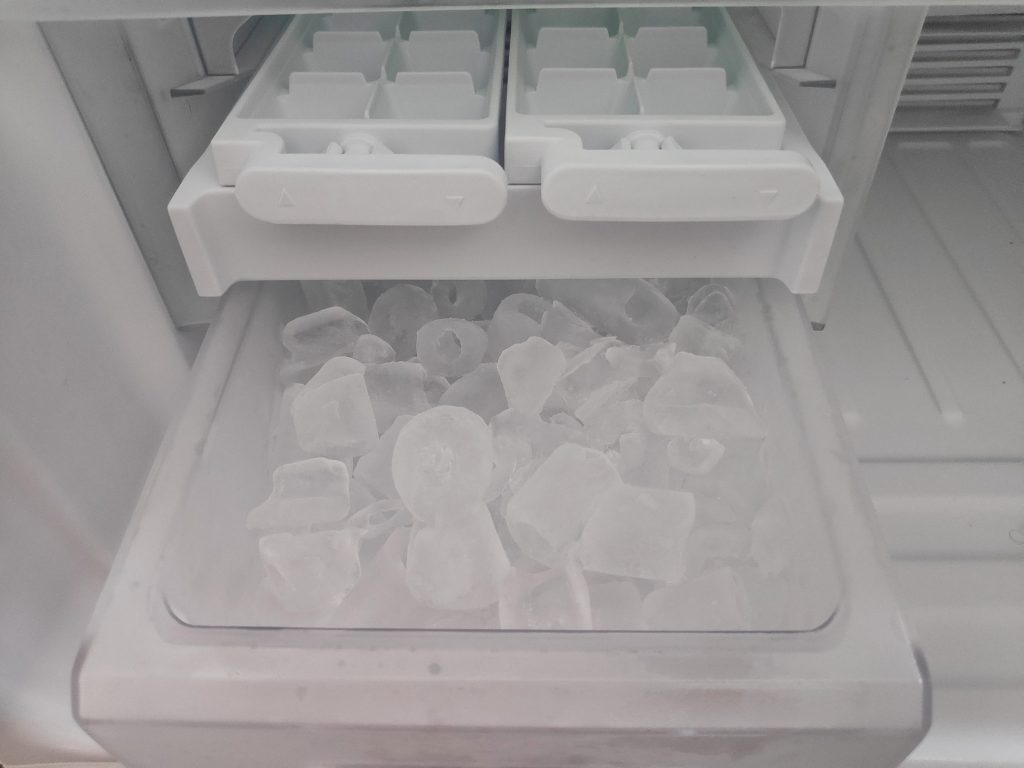
No ice, slow ice, cloudy ice Ice maker not working
Production that stopped, or halved over a season. Water supply, the freeze cycle and the condenser are the three places this ends up, and they are easy to tell apart.
- Stopped after a filter change
- Half the ice it used to make
- Cloudy cubes instead of clear
-
from $95 Diagnostic visit
We read the active and stored codes on site, then test the sealed system and the airflow before saying anything about the repair. The fee is credited toward the work when you go ahead.
- Active and stored codes read on site
- Sealed system and airflow tested
- Credited toward the repair
-
Priced after diagnosis Maintenance visit
In this climate condenser cleaning is seasonal rather than annual. A maintenance visit is the cheapest hour you will spend on a built-in unit, and it is how most sealed system failures get avoided.
- Condenser cleaned and airflow checked
- Door seals and drainage inspected
- Stored codes read and cleared
Questions people ask about this
How long should a Sub-Zero take to make ice?
Once running normally, expect a batch every couple of hours rather than a continuous supply, and a full bin over roughly a day. After a new installation, a filter change, a long door-open period or a power outage, give it a full 24 hours before concluding anything is wrong — a great many perfectly healthy ice makers get reported on hour six.
Why is my ice maker making small or hollow cubes?
That is a water supply problem far more often than an ice maker problem: low pressure, a partially closed valve, a restricted filter or a partly frozen fill line. The mold is filling incompletely. Fix the flow and the cubes come back to size.
I changed the water filter and now there is no ice at all.
Two common causes and both are easy. The filter may not be fully seated, which stops the flow entirely. Or the system has air in it from the change and needs flushing — run two or three gallons through the dispenser, or discard the first few batches of ice. Give it 24 hours after that.
The ice tastes bad even though it is being made.
That is a different problem from production and it usually is not the ice maker. Odor absorption in the compartment, an overdue filter or an air purification cartridge that is finished are the usual causes.
Troubleshooting
More guides like this one
-
Sub-Zero Door or Drawer Not Closing: Six Checks, in Order
The order matters more than the list. Start with the two checks that cost nothing — what is on the shelf, and whether the unit is level — because between them they account for most of the doors we are called out to look at.
Read more -

Sub-Zero Condenser Fan Not Running: What to Check Before Anyone Comes Out
The condenser fan is reachable from the front through the grille, which makes this one of the few checks an owner can genuinely complete. It is also the fastest route from a modest repair to a compressor, which is why it is worth an evening.
Read more -

How to Reset a Sub-Zero Refrigerator: Every Reset, and What Each One Clears
There is no reset button. There are four different resets, they clear different things, and one of them hides a service message instead of fixing what caused it. Which to use, in order, and when to stop.
Read more
Tell us the model number and what it is doing.
This article is based on:
- Official manufacturer documentation
- Internal repair procedures
- Technician repair history
- Company quality standards