Cost Expectations
What an Ice Maker Repair Costs — and When the Assembly Is the Cheap Answer
Published market figures put most ice maker repairs at $150 to $400, with a water inlet valve at $90 to $225 installed and a module or assembly at $150 to $400 depending on the unit. Those figures are for mainstream refrigerators; the same sources name built-in premium brands as pushing the top of the range. The important point is that an ice maker is a self-contained assembly, so replacing it whole is frequently cheaper than repairing the parts inside it.
The full guide
One fact that changes everything about the price
An ice maker is not part of your refrigeration system. It is a small self-contained machine — its own motor, its own heater, its own thermostat, its own water supply — that is bolted into the freezer and plugged in.
That single structural fact drives almost everything on this page:
- A dead ice maker tells you nothing about the refrigerator. They fail independently. A unit with a perfectly healthy sealed system will happily stop making ice.
- The usual repair is a replacement. The assembly comes out as one part and a new one goes in.
- Repairing the inside of an assembly is usually the expensive option, not the cheap one, because the labor to open one up exceeds the difference in parts price.
People expect the opposite on all three counts, which is why this repair is so often either panicked about or put off.
What the market says it costs
Published figures for ice maker work sit in a fairly tight band:
| Job | Published range | Notes |
|---|---|---|
| Ice maker module or assembly | $150–$400 | The most common repair by far |
| Water inlet valve, installed | $90–$225 | The valve itself is only $30–$60 |
| Overall, most ice maker repairs | $150–$400 | Across mainstream refrigerators |
Those numbers are for mainstream freestanding refrigerators, which is what the published sources measure. The same sources specifically name built-in premium brands as sitting at the top of the range and beyond, and that matches what we see: the parts are made for the model rather than bought generically, and getting to them in a built-in cabinet takes longer. Treat the table as the shape of the cost, not as a quote. The number comes after a diagnosis.
Why the valve is the interesting number
Look at the water inlet valve row again. The part costs $30 to $60. The installed job costs $90 to $225. Nearly all of that difference is labor.
That ratio explains most of what seems strange about appliance pricing. You are very rarely paying for the part. You are paying for somebody to identify which of five things it is, get to it in a cabinet designed to hide it, replace it, and confirm the machine works afterward.
It also explains why bundling matters. If a technician is already inside the freezer for the ice maker assembly, having them deal with a marginal fill tube at the same time costs a fraction of what a second visit would. Ask what else is worth doing while the unit is open — on a built-in, that question is worth real money.
The five causes, cheapest first
Before any of the figures above apply, work down this list. The first three cost nothing, and between them they account for a large share of the ice maker calls we take.
1. The arm or the switch is off. Every ice maker has a way to be told to stop, and every ice maker gets told to stop by accident — a bail arm knocked upward by a bag of frozen peas, a control switched off in a menu by somebody who was looking for something else. Check this first. Always.
2. The water supply is not arriving. A shutoff valve behind the unit that got nudged during a floor cleaning, a line that has been kinked, or a fill tube with a plug of ice in it. A fill tube freezes when water sits in it too long, which itself usually means the valve is weeping or the fill volume is wrong.
3. The filter is overdue. A clogged water filter restricts flow, and an ice maker that gets a partial fill makes hollow, small or misshapen cubes before it stops making them at all. Filters are consumables and the interval is shorter than most people keep to.
4. The inlet valve has failed. This is the first paid repair on the list, and it has a characteristic signature: the ice maker cycles as it should but nothing arrives, or the batches get progressively smaller. A weeping valve often shows up as water on the floor weeks before anyone connects the two.
5. The assembly itself. The motor, the mold heater or the thermostat inside the ice maker has stopped. The fix is a new assembly.
Hollow or small cubes are a water problem, not an ice problem. The mold is being filled partially. Work back up the water path — filter, valve, fill tube, supply pressure — rather than suspecting the ice maker. It is doing its job with what it is given.
Why "just replace the assembly" is usually right
It sounds wasteful. It generally is not, and here is why.
An ice maker assembly contains a motor, a gear train, a mold heater, a thermostat and a control, all in a housing that was assembled in a factory and was never designed to be opened in a kitchen. Diagnosing which of those five has stopped, opening the housing, sourcing the individual component and reassembling it takes substantially longer than swapping the whole thing — and labor is where the money is.
So on most units, the honest recommendation is the whole assembly. It comes with everything inside it new, it is a defined job with a defined price, and it does not bring anybody back in six weeks for the next component in the same housing.
The exception is worth knowing: if the failure is clearly outside the assembly — the valve, the line, the filter, the fill tube — then replacing the ice maker fixes nothing, and a technician who proposes that without checking the water path first is guessing. Ask which one they found.
A dead ice maker is not an emergency
This is the reassurance most people are actually looking for when they search this, so it is worth saying plainly.
Because the ice maker is a separate machine, its failure does not put your food at risk, does not mean the compressor is struggling, and does not get more expensive by waiting a week. The freezer around it goes on doing its job.
There are only two versions of this that need attention promptly, and both are about water rather than ice:
- Water on the floor, which means the supply side is leaking and is fed by household pressure
- A fill tube icing repeatedly, which floods the ice bin and eventually the freezer floor
Everything else can wait for a convenient appointment.
One local footnote. Ice makers get worked harder here than almost anywhere, because in this climate a household goes through ice all year rather than for three months of it. That extra duty is a real factor in how often we replace assemblies in South Florida, and it is the argument for keeping the water filter to its interval rather than to the reminder light — a restricted filter makes an ice maker work badly and constantly at the same time.
What to have ready when you call
- Does the ice maker try and fail, or do nothing at all?
- Are the cubes normal, hollow, small, or absent?
- Is the freezer itself holding temperature?
- When was the water filter last changed?
- Is there water anywhere it should not be?
Those five answers usually place the problem on one side or the other of the line that matters — the water path or the assembly — and that is the line the whole price range hangs on.
If it turns out to be a repair
What this leads to, and what it costs
Every job on this site is priced the same way: an on-site diagnostic first, the figure agreed in writing before anybody starts.
-
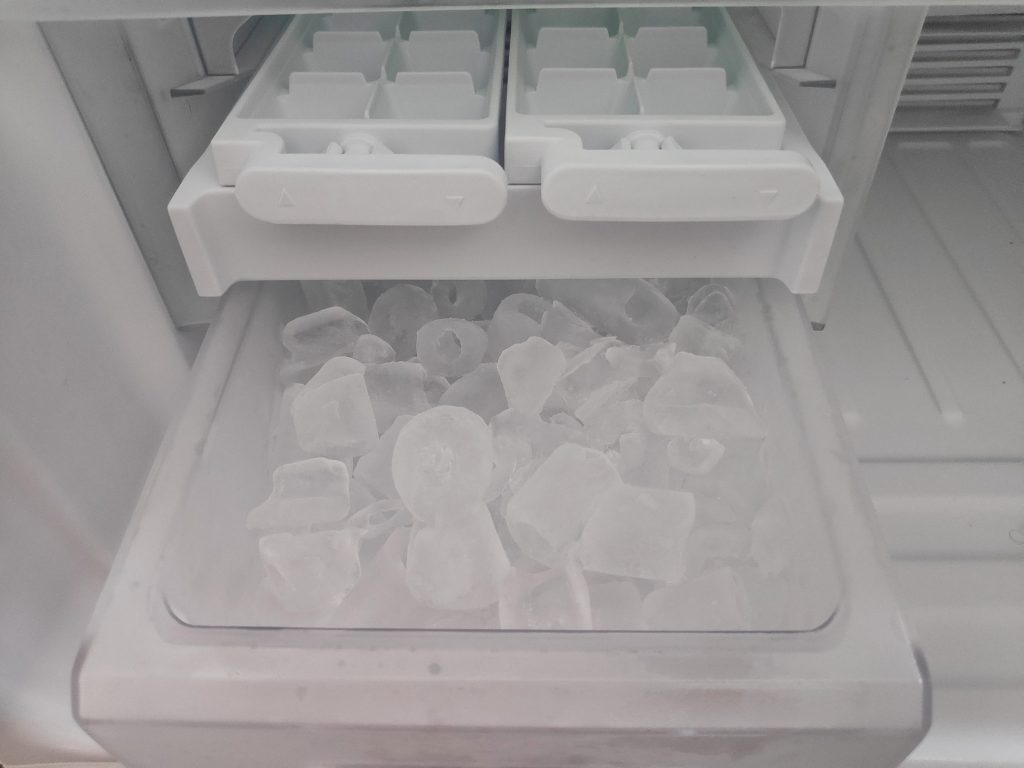
No ice, slow ice, cloudy ice Ice maker not working
Production that stopped, or halved over a season. Water supply, the freeze cycle and the condenser are the three places this ends up, and they are easy to tell apart.
- Stopped after a filter change
- Half the ice it used to make
- Cloudy cubes instead of clear
-

Clear ice · Outdoor · Pump Ice makers
Undercounter, clear-ice and outdoor units, with or without a pump.
- No ice, or slow production
- Cloudy ice instead of clear
- Leaks and drain blockages
-
from $95 Diagnostic visit
We read the active and stored codes on site, then test the sealed system and the airflow before saying anything about the repair. The fee is credited toward the work when you go ahead.
- Active and stored codes read on site
- Sealed system and airflow tested
- Credited toward the repair

Questions people ask about this
How much does it cost to fix an ice maker?
Published market figures put most ice maker repairs between $150 and $400, with a water inlet valve at roughly $90 to $225 installed. Those are figures for mainstream freestanding refrigerators. On a built-in the access is slower and the parts are model-specific, so expect the upper end, and expect the actual number after a diagnosis rather than over the phone.
Is it worth repairing an ice maker or should I replace it?
It is nearly always worth repairing, because on most units the repair is a replacement — of the ice maker assembly, not of the refrigerator. The assembly comes out as a unit and a new one goes in. What is rarely worth it is dismantling an assembly to replace an individual motor or thermostat inside it: the labor to do that usually exceeds the price difference.
Does a broken ice maker mean my refrigerator is failing?
No, and this is the most useful thing to know about them. The ice maker is a self-contained machine with its own motor, heater, thermostat and water supply, fitted inside the freezer. It can fail completely while the refrigeration system is in perfect health. A dead ice maker in a cold freezer is an ice maker problem and nothing more.
Why is my Sub-Zero not making ice?
The common causes, cheapest first: the arm or switch is in the off position, the water supply is shut off or the line is frozen, the filter is overdue and restricting flow, the inlet valve has failed, or the assembly itself has stopped. That order is worth working through because the first three cost nothing and account for a large share of the calls.
How long should an ice maker last?
Shorter than the refrigerator around it, which surprises people. It is a small machine that cycles many times a day, with a motor, a heater and moving parts, and it is normally the first assembly in a refrigerator to be replaced. Replacing one is a routine event in the life of a long-lived unit rather than a sign that the unit is on its way out.
Cost Expectations
More guides like this one
-

What a Wine Cabinet Repair Costs, and Why It Is Not a Refrigerator Repair
Wine storage fails differently from food storage, and the money follows the difference. Two degrees out ruins a collection long before it would ruin dinner — and the cheapest repairs on this list are the ones people put off longest.
Read more -

Why a Sub-Zero Repair Costs More Than the Same Repair on a Mainstream Unit
Our cost pages give the figure for each job. This is the question that comes before them: why that figure is higher than the number a general appliance site quotes. There are four reasons, and none of them is the badge on the door.
Read more -

Is It Worth Repairing a Sub-Zero Refrigerator? How the Math Actually Works
The 50% rule that works for a $900 refrigerator falls apart on a built-in. Here is the arithmetic that actually applies, and the three questions that decide it before any number does.
Read more
Tell us the model number and what it is doing.
This article is based on:
- Official manufacturer documentation
- Internal repair procedures
- Technician repair history
- Company quality standards