Common Problems
Frost and Ice Building Up in a Sub-Zero: What It Is Telling You
A Sub-Zero defrosts itself, so visible ice build-up means part of that system has stopped working or humid air is getting in faster than the unit can clear it. Ice on the back wall of the freezer points to the defrost system. Ice around the door or on the ceiling points to a seal letting air in. A slab under the freezer floor points to a blocked drain. Frost on food only usually means the packaging, not the machine.
The full guide
Your refrigerator is supposed to handle this itself
Every refrigerator makes frost. Each time a door opens, room air comes in carrying moisture, and that moisture freezes onto the coldest surface it can find — the evaporator coil, hidden behind a panel in the freezer.
A frost-free unit deals with that on a schedule. Several times a day it stops cooling, energizes a heater next to the coil, melts the accumulated frost, sends the meltwater down a drain to a pan near the compressor, and goes back to work. You are not supposed to see any of it happen.
So when you can see ice, one of two things is true:
- The defrost cycle is not completing. Frost accumulates faster than it is being removed, and after a few weeks it is thick enough to notice.
- Moisture is arriving faster than the cycle can cope with. The cycle is fine; the load on it has gone up.
Which of those it is comes down to where the ice is.
Read the location
On the back wall of the freezer
This is the classic defrost problem, and the most common of the lot.
The evaporator sits directly behind that back panel. When the defrost cycle stops working, the frost that would normally be melted away each time just keeps building on the coil, and eventually it grows through the vents and appears on the panel itself as a sheet.
Three parts make that cycle happen — a heater, a sensor that decides when to run it, and the control that ties them together — and any of them stopping produces exactly the same symptom. Which one it is takes measurement, not guessing.
The characteristic pattern owners notice first is not actually the ice. It is that the freezer is still fine while the refrigerator has gone warm. That happens because a coil packed with ice cannot pass enough air, and the refrigerator compartment is the one fed by that airflow.
Around the door opening or on the ceiling
Ice that forms near the door, along the top edge, or in a band around the opening is not a defrost problem. That is humid room air getting in and freezing where it meets cold surfaces.
The causes are all mechanical and none of them are exotic:
- A door seal that has hardened, flattened or torn
- A door held very slightly open by something on a shelf
- A freezer drawer that is not pushing fully home
- A door that has dropped on its hinge and no longer meets the cabinet square
The paper test settles it in seconds. Close the door on a sheet of paper and pull it out. If it slides free without resistance, the seal is not gripping there.
Gaskets have a harder life in South Florida than the design assumes. Heat and humidity harden the rubber, and every degree of ambient temperature means more cycling, which means more of the flexing that wears a seal out. It is the part we replace most often, and door-edge icing is usually how it announces itself.
A slab under the freezer floor
If the ice is a sheet under the bottom of the freezer, sometimes with the baskets frozen down onto it, the drain is blocked.
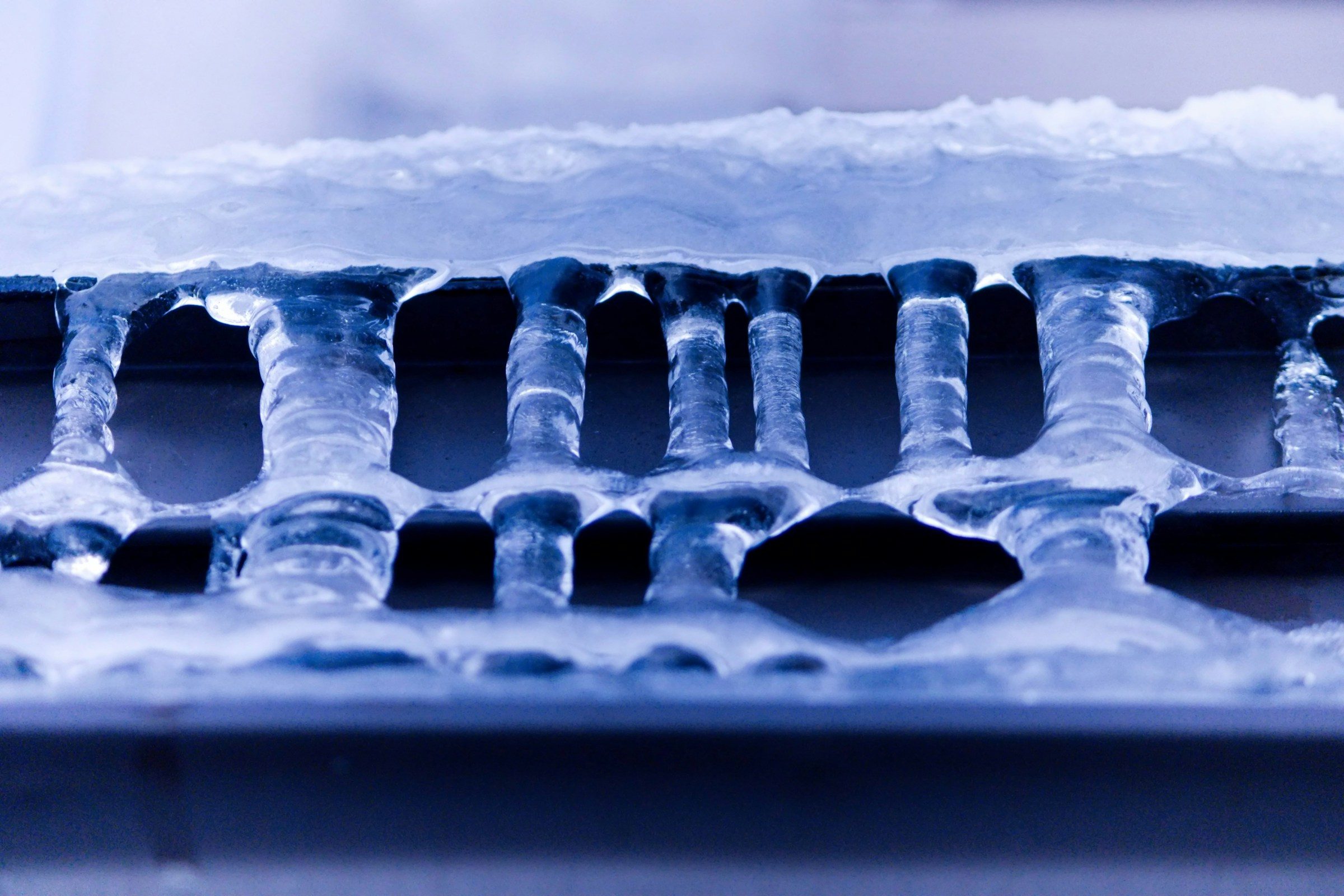
The defrost cycle is running. The frost is melting. But the meltwater cannot get away, so it sits in the bottom of the compartment and refreezes on the next cooling cycle. Each cycle adds a layer, which is why this one grows in visible strata like a geological section.
This is the same blockage that produces water in the bottom of a refrigerator compartment; it just shows up as ice instead of water because of where it lands.
On the food, and only on the food
A light frost on packages, on ice cream, on anything with air trapped in or around it — that is usually not the machine. It is moisture in the air inside the cabinet condensing onto cold surfaces, and the food is the coldest surface with the most texture to catch it.
Worth checking, but usually harmless — and if the complaint is food freezing rather than frost forming, that is a settings and placement question, covered in what to set a Sub-Zero to:
- Are the doors being opened often, or held open while people decide?
- Is anything wrapped loosely, or in packaging that has been opened and folded shut?
- Is the freezer very full, or very empty? Both change how air moves.
Why ice is expensive if you leave it
Ice does not stay a cosmetic problem for long, because of what it does to airflow.
The whole design depends on air moving across a cold coil and then being blown where it is needed. Pack that coil with ice and the airflow drops. The compartments start to lose temperature, so the unit runs longer, which means more runtime, more frost, and more ice. It is a loop that tightens on itself.
Along the way, three things tend to happen:
- The refrigerator warms up while the freezer stays cold. This is the symptom most people report, and it sends them looking for a refrigerator problem when the cause is in the freezer.
- The evaporator fan starts hitting ice, which sounds like a rhythmic tick or a slap, and ends with a cracked blade.
- The compressor runs continuously, which is wear it does not recover, in service of a problem that started with a heater worth a fraction of it.
Defrosting the unit by hand does work — as a stopgap, and how to defrost a Sub-Zero properly sets out the way to do it without damaging anything. Emptying it, switching it off, and letting it stand with the doors open for a day will clear the ice and restore normal cooling for a while. That is genuinely useful if you need to get through a holiday weekend. What it does not do is fix anything: if the defrost system is not running, the ice comes back on exactly the same schedule.
What you can fix, and what you cannot
Worth doing yourself:
- Test the door seals with a sheet of paper and clean them — hardened gaskets are sometimes just dirty ones, and a clean seal grips better
- Check nothing on a shelf is holding a door open
- Make sure drawers and baskets are pushing fully home
- Flush the drain, if your model gives you access to it, with warm water
- Defrost the cabinet manually to buy yourself time
Not worth doing yourself:
- Chipping ice off anything. The evaporator coil is soft aluminum tubing with refrigerant in it, and it is directly behind the panel people attack with a screwdriver. Puncturing it converts a defrost repair into a sealed-system repair, which is one of the largest numbers on our price list.
- Pushing anything rigid down the drain tube.
- Running a hair dryer inside the cabinet. It melts the plastic liner long before it clears the ice behind it.
The single most expensive mistake an owner can make with a frosted-up freezer is to attack the ice with something sharp. Everything behind that back panel is soft metal under pressure. If the ice will not come away with warm water and patience, leave it.
When to book somebody
- Ice on the back wall that returns within a few weeks of defrosting
- A freezer that is fine while the refrigerator is warm
- A sheet of ice under the freezer floor
- Any sound of a fan striking something
- The unit running constantly as well as icing
Bring one piece of information to that call: where the ice is, and whether it comes back after you defrost it. Ice that returns on a schedule is a defrost system; ice that stays away is an air leak you have since fixed. Those two answers point at entirely different parts, and knowing which saves the first half of the visit.
If it turns out to be a repair
What this leads to, and what it costs
Every job on this site is priced the same way: an on-site diagnostic first, the figure agreed in writing before anybody starts.
-
Frost, or not cold enough Freezer not freezing
A freezer running warm, frosting heavily, or holding a temperature that looks right on the display and is not right in the drawer.
- Ice cream soft, everything else fine
- Heavy frost on one shelf
- Display reads correctly, contents say otherwise
-
from $650 Evaporator replacement
Usually follows a sealed system diagnosis. Heavy frost on one shelf, a zone that will not hold, or a defrost cycle that never quite finishes are the symptoms that lead here.
- Frost build-up on a single zone
- Defrost heater and thermistor checked with it
- Access planned before we arrive
-
from $95 Diagnostic visit
We read the active and stored codes on site, then test the sealed system and the airflow before saying anything about the repair. The fee is credited toward the work when you go ahead.
- Active and stored codes read on site
- Sealed system and airflow tested
- Credited toward the repair

Questions people ask about this
Why is my Sub-Zero freezer icing up?
Because either the defrost system has stopped clearing frost off the evaporator, or humid air is entering faster than the unit can deal with. These units are frost-free by design: they melt the frost off their own coil on a schedule and drain the water away. Visible ice means that cycle is not completing, or that a door seal, a drawer, or a door left ajar is feeding the cabinet with moisture.
Why is there frost forming in my freezer?
A light dusting of frost on packaging is normal and comes from moisture in the air around the food. Frost you can scrape as a layer, especially on the back wall or the ceiling, is not. The difference is location: frost on things is usually harmless, frost on the cabinet itself is the unit telling you something.
Does a Sub-Zero need to be defrosted manually?
No. That is the whole point of a frost-free design, and a unit that needs manual defrosting is reporting a problem rather than asking for maintenance. Defrosting it by hand will clear the symptom for a few weeks, which is worth doing to get through a weekend, but the ice will come back on the same schedule until the underlying cause is dealt with.
What causes the coils in a refrigerator to freeze up?
Frost forms on the evaporator coil constantly — that is normal, and the defrost cycle melts it away several times a day. A coil that freezes solid means either that cycle has stopped completing, or so much humid air is entering that the cycle cannot keep up with it. The first is a repair; the second is usually a door seal, and in this climate a small gap admits a surprising amount of moisture.
Is ice build-up damaging the refrigerator?
Indirectly, yes. Ice on the evaporator blocks the airflow the unit depends on, so the compressor runs longer and longer to move less and less cold air. A fan blade striking accumulated ice will eventually crack. And a cabinet that is running continuously because of ice is wearing out a compressor to solve a problem that started somewhere much cheaper.
Common Problems
More guides like this one
-

Why Your Sub-Zero Is Leaking Water, and Which of the Four Sources It Is
Water on the floor has four possible origins, and you can tell them apart in about five minutes without tools. Which one it is decides whether this is a twenty-minute job, a plumbing job, or something that should not wait.
Read more -
Every Noise a Sub-Zero Makes, and Which Ones Mean Something
Most of the sounds that bring people to a search box are the unit working exactly as designed. A few are not. Here is the whole catalog — what makes each noise, and the four that are worth a phone call.
Read more -

Sub-Zero Refrigerator Not Cooling but the Freezer Is Fine: What That Split Means
One compartment warm and the other still frozen is not half a problem — on a Sub-Zero it is a specific one. Here is what the split rules out, what it usually turns out to be, and how long the food has.
Read more
Tell us the model number and what it is doing.
This article is based on:
- Official manufacturer documentation
- Internal repair procedures
- Technician repair history
- Company quality standards