Safety & Risks
How Long Food Stays Safe in a Refrigerator Without Power — a South Florida Answer
An unopened refrigerator keeps food safe for about 4 hours without power. A full freezer holds for about 48 hours, a half-full one for about 24. The number that decides everything is 40°F: perishable food held above it for more than 2 hours should be discarded, however good it looks or smells.
The full guide
The numbers, first
These come from the USDA's food safety guidance and they are the ones to plan around.
| Situation | How long food stays safe |
|---|---|
| Refrigerator, door kept closed | About 4 hours |
| Freezer, full, door kept closed | About 48 hours |
| Freezer, half full, door kept closed | About 24 hours |
| Perishable food held above 40°F | 2 hours, then discard |
Every one of those assumes the door stays shut. A refrigerator with the door closed is a cooler with good insulation; a refrigerator that gets opened every twenty minutes to check on things is a cupboard. Opening it to look is the most common way people cut the four hours in half.
Why 40°F is the number that matters
The hours in that table are estimates for a typical unit in a typical room. 40°F is not an estimate — it is the line.
Below 40°F, bacterial growth on perishable food is slow enough that the food stays safe. Above it, growth accelerates, and the USDA's guidance is that perishables held above 40°F for more than two hours should be discarded.
That is why a thermometer beats a clock. A well-insulated built-in in a cool room may still be at 38°F after six hours. A unit in a hot kitchen with a weak door gasket may be at 45°F after three. If you know the temperature, you do not need to guess at the hours.
Put a thermometer in each compartment now, before you need it. An appliance thermometer costs almost nothing and turns the entire question from a judgment call into a reading. After an outage, it is the difference between throwing out a full refrigerator to be safe and keeping most of it because you know it never went above 39°F.
What to keep and what to throw out
Once power is back and the compartment has been above 40°F for more than two hours, the rule is simple and unforgiving: discard perishables, whatever they look like.
Discard: meat, poultry, fish and shellfish; eggs and egg dishes; milk, cream, yogurt, soft cheese and cottage cheese; cooked leftovers and casseroles; cut fruit and cut vegetables; soft or cooked pasta and rice; opened baby food and formula; cream-based sauces and dressings; anything with mayonnaise that was already opened.
Usually fine: hard cheeses; butter and margarine; whole uncut fruit and vegetables; opened jars of jam, jelly, mustard, ketchup, relish and olives; peanut butter; bread and pastries without cream; fruit juices and unopened bottled drinks.
The freezer is a separate judgment. Food that still contains ice crystals, or that has stayed at or below 40°F, can be refrozen — with some loss of quality, not of safety. Food that has fully thawed and warmed above 40°F for more than two hours should go.
Never taste food to decide. The organisms that cause foodborne illness do not reliably change how food smells or tastes. Food that smells fine can make you seriously ill, and the amount you have to taste to check is enough to do it. When you cannot establish the temperature history, throw it out — the cost of a refrigerator's contents is not close to the cost of being wrong.
The coin trick, for outages you slept through
The problem with all of this is that you often do not know what happened. The power went at some point in the night, came back at some point before you woke up, and the freezer is cold now — but was it cold the whole time?
There is a decades-old solution and it works.
- Fill a small cup or shallow container with water and freeze it solid.
- Put a coin on top of the ice.
- Leave it in the freezer permanently.
If you come home and the coin is still on the surface, the freezer never thawed. If the coin has sunk to the middle or the bottom, the contents thawed and refroze, and you now know to treat the food accordingly. It costs nothing and it answers the one question nobody else can.
Preparing a built-in before a storm
This is where being in South Florida changes the advice. A hurricane outage is not a four-hour inconvenience — it can run for days, and everybody's plan gets tested at once.
A built-in cannot be moved. No wheeling it to a neighbor's generator, no putting it in the truck. Whatever cold it is going to have, it has to already be holding. That shifts the whole strategy from restoring cold to storing it.
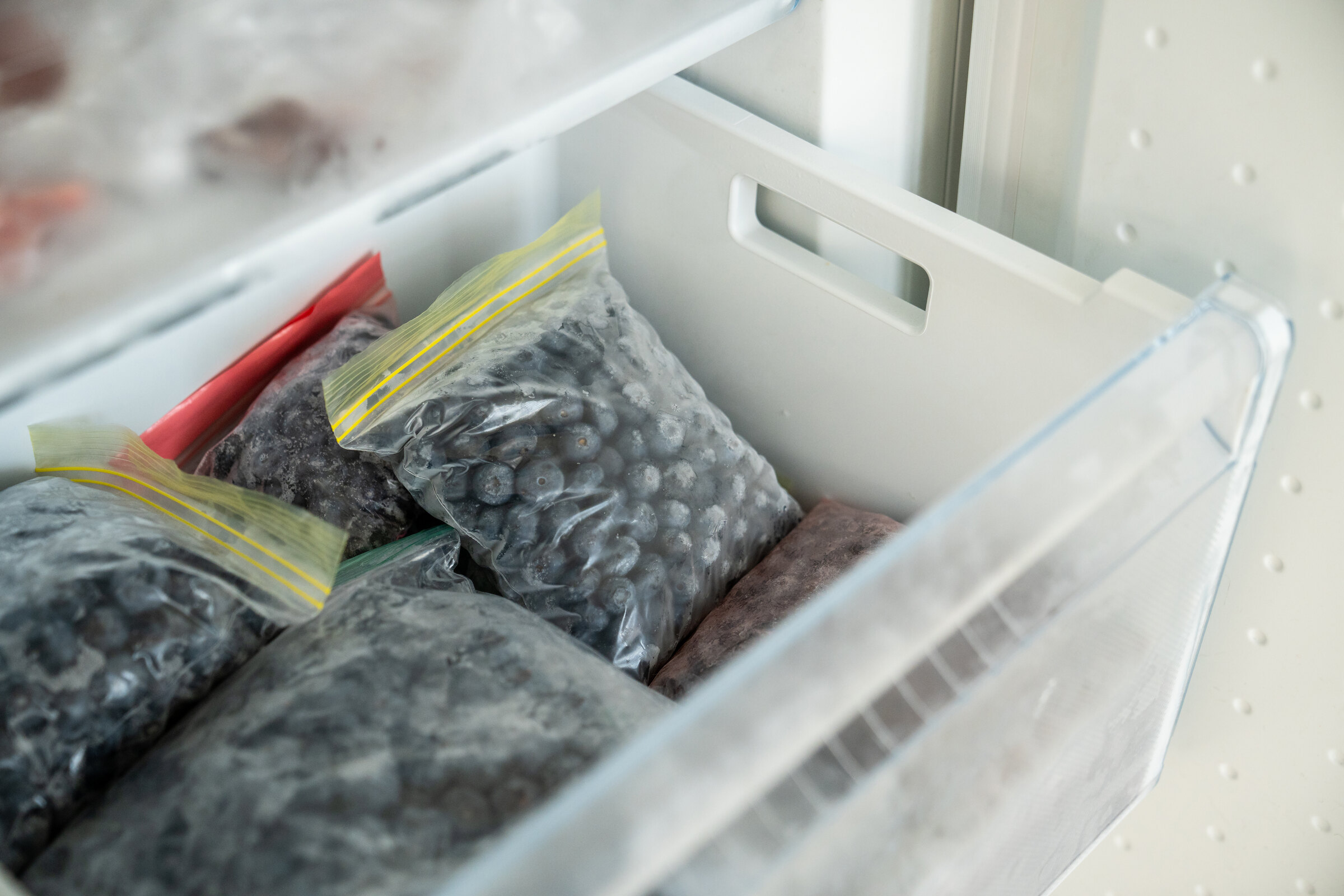
Fill the freezer before the storm. A full freezer holds roughly twice as long as a half-empty one, because the frozen mass is the thermal store. Freeze bottles or containers of water in the days before — they cost nothing, they fill the space, and afterward they are drinking water.
Consolidate. Move what is genuinely perishable from the refrigerator into the freezer before the outage. The freezer is the compartment with the long window; the refrigerator's four hours will be gone before the first band clears.
Turn both compartments to their coldest setting a day ahead, so everything starts colder.
Have a cooler and ice ready for medication, baby formula and anything that will not fit.
Know your building's rules. In a lot of Miami-Dade and Broward condo towers, the generator carries the elevators, the corridors and the pumps — not the kitchen circuits in the units. Assume your refrigerator is on its own unless you have confirmed otherwise.
After the power comes back
The outage is over. The unit is not necessarily fine.
Check that it is actually cooling, not just lit. Lights and a display prove there is power, not that the compressor is running. Put a thermometer in and check it four hours later.
Expect it to take hours, not minutes. A unit that has been off for a day is pulling a whole cabinet of warm mass back down. Give it time before deciding it has a problem.
Watch for the specific ways an outage damages a refrigerator. The restoration itself is often harder on the electronics than the outage: surges and brownouts as the grid comes back are exactly what kills control boards. If your unit powers up but behaves strangely — a display that does not respond, a compartment that will not come down, a compressor that will not start — that is a real diagnosis with a name, and we have a page for it: not cooling after a power outage.
A surge protector is worth more here than most places. Not a guarantee, but the cheapest insurance available against the failure mode that follows every storm season — and there is more on which kind to buy, and why a desk power strip is not one, in powering a Sub-Zero safely.
When to call somebody
Call if the unit does not restart, if it powers up but does not cool within a few hours, if there is a service code on the display, or if it is making a noise it did not make before.
Do not call because the food is ruined and you want somebody to confirm it. The table at the top of this page is the same information a technician would give you at the door, and it is free.
If it is the unit rather than the food, tell us the model number and what happened — how long the power was out, and what the unit did when it came back. After a storm those two details decide whether it needs a part or a reset, and they are the difference between a slot this week and a slot next week.
If it turns out to be a repair
What this leads to, and what it costs
Every job on this site is priced the same way: an on-site diagnostic first, the figure agreed in writing before anybody starts.
-
Storm season Not cooling after a power outage
A unit that came back up and never quite recovered, or did not restart at all. What a surge does to this equipment, and what is worth checking before booking.
- Restarted, but never came back to temperature
- Ice maker at half production since
- Display blank, or a code that arrived with the storm
-
from $95 Diagnostic visit
We read the active and stored codes on site, then test the sealed system and the airflow before saying anything about the repair. The fee is credited toward the work when you go ahead.
- Active and stored codes read on site
- Sealed system and airflow tested
- Credited toward the repair
-
from $450 Control board repair
Boards vary sharply by series, and parts for legacy units can take a few days to source. We confirm the board is the problem before ordering one — a code on the display is not proof by itself.
- Board confirmed before it is ordered
- Legacy 600 and 700 Series supported
- Display and touch panel problems

Questions people ask about this
Can I tell by smell or taste whether food is still safe?
No, and this is the most dangerous belief in this whole subject. The bacteria that cause foodborne illness do not reliably change how food looks, smells or tastes. Spoilage organisms do, which is why people trust the test — but they are not the ones that make you ill. Use a thermometer, use the clock, and never taste to check.
Does refreezing thawed food make it unsafe?
Not automatically. Food that still contains ice crystals, or that has stayed at or below 40°F, can be refrozen — the quality suffers but the safety does not. Food that has been above 40°F for more than two hours should be discarded rather than refrozen.
My Sub-Zero is built in and I cannot move it. What do I do?
You prepare in place. Freeze water containers in advance so the freezer is full, freeze a shallow tray of water and keep a coin on top of it, consolidate perishables into the freezer before the outage, and have a cooler and ice ready for what will not fit. A built-in cannot be wheeled to a generator, so the plan has to be about holding cold rather than restoring it.
Should I run my refrigerator on a portable generator?
It can be done and it is common here, but it belongs to whoever installed or supplied the generator, not to an appliance guide. What matters from our side: never run a generator indoors, in a garage, or near a window — carbon monoxide from generators kills people after every major storm. And a refrigerator drawing from an undersized or unstable supply can damage its own electronics.
Safety & Risks
More guides like this one
-
A Burning or Electrical Smell From a Refrigerator: What to Do in the First Minute
This is the one symptom on this whole site where the correct first move is the breaker, not the phone. What that smell usually is, the short list of things that produce it, and why a refrigerator can genuinely start a fire.
Read more -
Refrigerant Leaking From a Refrigerator: the Real Risk and the Right Response
Most of what is written about this is frightening and wrong in both directions. What is actually in your refrigerator, what a leak does and does not do to you, and why this is the one repair nobody should attempt at home.
Read more -

Mold in a Refrigerator: Where It Grows in a Humid Climate and How to Get It Out
Four hiding places, and only one of them is the shelf you can see. In South Florida all four fill faster than the manuals assume — and this is the rare safety problem an owner can genuinely fix in an afternoon.
Read more
Tell us the model number and what it is doing.
This article is based on:
- Official manufacturer documentation
- Internal repair procedures
- Technician repair history
- Company quality standards